
Issue No. 4 · · 5-minute read
The FTC is suing to stop your two biggest suppliers from merging
Plus what new grads owe, a screwworm travel memo, and clients who show up with AI answers.

Key takeaways
- On Nov 13, 2026, the FTC and 13 state attorneys general sued in federal court in New York to block Covetrus's $3.5 billion purchase of MWI Veterinary Supply from Cencora.
- The states allege the combined company would control more than 50% of the relevant markets for supplying vet clinics; the companies agreed not to close before Dec 4, 2026.
- Covetrus called the FTC's view "narrow and outdated" and says online marketplaces are used by more than 60% of US practices.
- In an Elanco survey of 2,018 US adults, 38% of pet owners said they had moved medication buying outside the clinic in the last year or two; a vet's recommendation was the top reason to switch medications.
- Week of Nov 1 to 7: visits −1.9% and revenue +1.8% year over year; services +2.7% vs products −1.8% (Vetsource/AVMA tracker).
- AVMA 2026 senior survey: average starting pay $131,784, record average vet school debt of $185,424, and only 19.9% of new grads offered student loan repayment.
THE LEAD
This week's big story
The FTC is suing to stop your two biggest suppliers from merging
On Friday, Nov 13, the Federal Trade Commission and 13 state attorneys general sued in federal court in New York to block Covetrus from buying MWI Veterinary Supply for $3.5 billion. Covetrus is owned by private equity firms Clayton, Dubilier & Rice and TPG. MWI belongs to Cencora. The FTC says the two are each other's closest competitor, and calls years of their fight for clinic business an "all-out price war." The commission voted 2-0 to bring the case (dvm360, Nov 13).
Here is what the states say is at stake:
- More than half the market. The combined company would control more than 50% of the relevant markets for supplying vet clinics (New York AG, Nov 13).
- Three big names, not four. Most products reach US practices through three national suppliers: Covetrus, MWI and Patterson Veterinary (California AG, Nov 13).
- A backup supplier. When one distributor runs short of a vaccine or drug, clinics can often turn to the other. California says the deal would remove that safeguard (California AG).
- A hard date. The companies agreed not to close before Dec 4. The states want a preliminary injunction after that (New York AG).
Covetrus says the FTC has it wrong. In a statement the same day, it called the agency's view of the market "narrow and outdated." It says online marketplaces are now used by more than 60% of US practices and let clinics order from 40+ distributors in one cart. It says it is "fully prepared" to defend the deal in court (Covetrus, Nov 13).
Meanwhile, your pharmacy is already under pressure from the other side. In an Elanco survey of 2,018 US adults in October, 38% of pet owners said they had moved medication buying outside the clinic in the last year or two. Asked where they buy, 37% named an in-person vet clinic and 31% an online pet pharmacy. The good news: a vet's recommendation was the top reason owners would switch medications. Discounts and rebates moved only 3% (Elanco, Nov 6). Elanco makes and sells pet medicines, so read it as a vendor's survey.
The weekly numbers point the same way. In the week of Nov 1 to 7, services revenue was up 2.7% from a year earlier while product revenue fell 1.8% (Vetsource/AVMA tracker).
So what: nothing changes on your invoices today, and a judge will decide the case. But the price war the FTC describes is happening right now, so use it:
- Know your split. Pull 12 months of distributor invoices. Write down what you spent with each supplier, and list your top 25 items by dollars.
- Get a second quote while both are still competing. Price your top 25 items with at least two suppliers, and keep the quotes on file. That's your baseline if prices move later.
- Read your rebate terms. Check volume tiers, auto-renewals and any exclusivity clauses before you sign or renew anything long. Have your own attorney or buying group review a big contract.
- Protect the pharmacy with the recommendation. Owners say your advice matters more than a coupon. Make sure every script leaves with a clear recommendation and an easy way to refill through you. Our vet practice EBITDA guide shows how cost of goods hits what your practice is worth.
VITALS
5 numbers that moved
- −1.9%: Practice visits, week of Nov 1 to 7 vs a year earlier. Revenue was up 1.8% (Vetsource/AVMA tracker)
- +2.7% vs −1.8%: Services vs products revenue, same week (Vetsource/AVMA tracker)
- −9.1%: Months of heartworm protection dispensed, year over year. Flea/tick was −6.7% (Vetsource/AVMA tracker)
- +1.9%: Oregon visits, still the only state with positive visits. Oregon also leads revenue growth at 7.5% (Vetsource/AVMA tracker)
- 7%: Share of consumers who would cut pet health spending under money pressure. For dining out and entertainment it was 54% (Elanco, Nov 6)
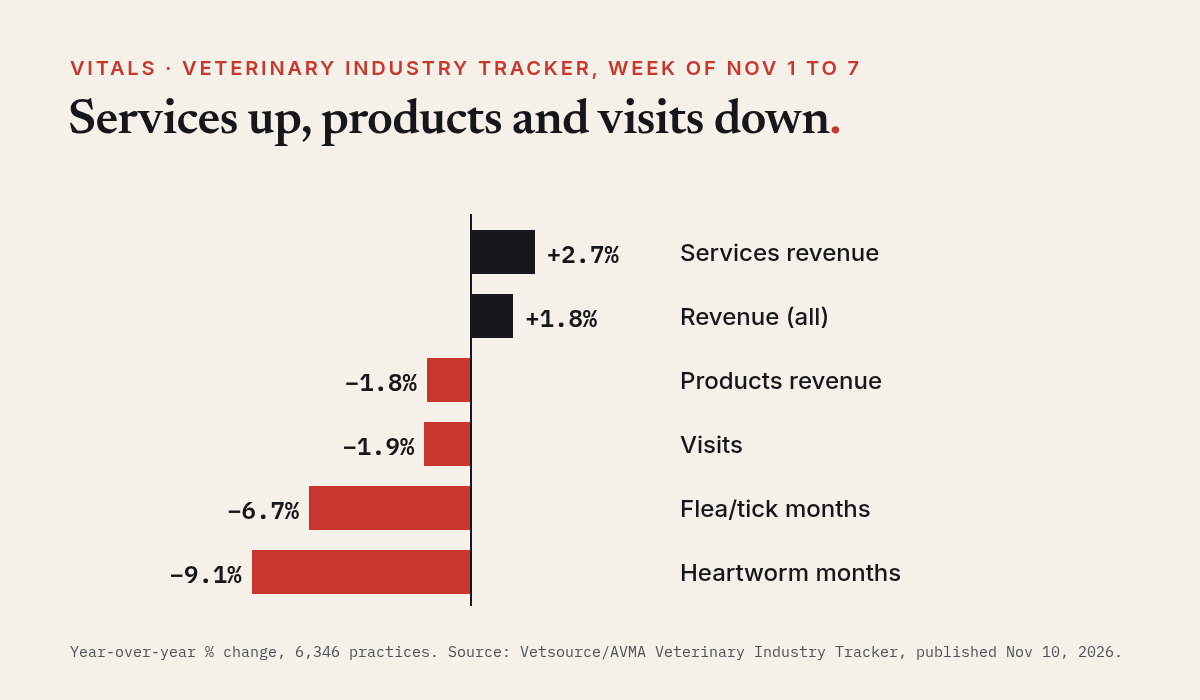
The tracker covers 6,346 practices, averaging $2.1M in revenue and 9.6K visits per practice over the last 12 months. Over 12 months, revenue is up 3.4% and visits are down 2.0%. Tracker figures can be revised as data comes in.
BUYOUT BOARD
Deals & ownership tracker
- A five-hospital group founded in 1954 joins a platform. Windcrest Animal Hospital Group in northern Delaware is partnering with COVE Animal Health, a group funded by a private equity firm. All five hospitals keep their names. Terms weren't disclosed. Windcrest started as a one-doctor practice and now runs 24/7 emergency care. Its leaders said the demands of recruiting and keeping doctors, paying for technology and equipment, and adapting to a changing profession had grown (Delaware Business Now, Nov 6).
- Your referral list may have a new owner. Animal Outpatient Specialty Network bought a group of outpatient specialty practices, including clinics under the Eye Care for Animals, Dermatology for Animals, Veterinary Cancer Group, and Dentistry and Oral Surgery for Animals names. It now has more than 300 specialists and residents and calls itself the largest dedicated outpatient specialty business in the US. No price was given (AOSN, Nov 3).
So what: Windcrest's list of reasons is one every multi-doctor independent will recognize. If you're weighing the same choice, start with what your practice is worth on its own and what you'd give up. Our guides to selling a vet practice and how valuations work list the questions to settle first. And if you refer to any of the AOSN brands, check whether your contact, pricing or report turnaround changes. Talk to your own attorney and CPA before you sign anything.
PEOPLE
Hiring, pay and benefits
- New grads owe more and earn less, after inflation. The AVMA's 2026 senior survey puts average starting pay for new grads in full-time jobs at $131,784, or $127,046 in 2025 dollars. The gap between new-grad real income and the whole profession's widened to 28% from 19% a year earlier. Average vet school debt hit a record $185,424, or $227,588 for those who borrowed, and 43.3% owe $200,000 or more (AVMA News, Oct 8).
- What they're offered. 58.7% of new grads taking full-time jobs got a signing bonus, but only 19.9% got student loan repayment. Among all vets in the AVMA's census, loan repayment topped the list of benefits people want but don't have (AVMA News).
So what: a one-time signing bonus is common, so it doesn't set you apart. Loan help does, and you can spread it over years, which helps with retention. Our guide to offering a student loan repayment benefit covers how to set one up, and our veterinarian salary guide shows how to build a pay range you can defend. Check the tax treatment with your CPA.
Hiring? Post it on Rounds Jobs, free for independent clinics. We review every listing before it goes live, and listings that show pay go to the top. Post a job or browse open roles.
TRIAGE
3 things to handle this week
- Price your top 25 items before Dec 4. That's the earliest the Covetrus and MWI deal could close. Get quotes from at least two suppliers and save them with the date. Whatever the court decides, you'll know what you were paying (New York AG).
- Brief the front desk on holiday pet travel. Arizona has confirmed 6 New World screwworm cases in animals, including 2 dogs. A Nov 9 state memo says dogs and cats leaving an infested zone need a state permit and an electronic health certificate, and USDA-accredited vets have to check the destination state's rules (dvm360, Nov 13). If clients are bringing pets from Arizona for Thanksgiving, have your team ask about travel plans early. (Clinical questions are your medical team's call.)
- Ask clients what AI told them. In a HABRI and Chewy Health survey, 36% of pet owners said they've used AI for pet care. Among those who have a vet, 67% felt more informed before a visit (HABRI, Nov 10). Add one line to your intake: "Did you look anything up before today?" It saves time in the exam room. HABRI and Chewy's free guide, The Bond Factor II, has talking points. (Chewy also sells pet medications.)
Previously in Vet Rounds
Last week, in Issue No. 3: a quarter of your patients pay 62% of the bills, we looked at who pays the bills. This issue looks at who supplies the shelves.
Get the business of vet practice in five minutes, every Monday.Free. Unsubscribe any time. We never sell or share your email.
Subscribe freeGet next Monday’s brief
Free, every Monday by 6 am ET. Five minutes, every number sourced.
Sources
All sources accessed November 2026 (PT).
- dvm360, Nov 13: www.dvm360.com
- New York AG, Nov 13: ag.ny.gov
- California AG, Nov 13: oag.ca.gov
- Covetrus, Nov 13: covetrus.com
- Elanco, Nov 6: www.elanco.com
- Vetsource/AVMA tracker: veterinaryanalytics.com
- Delaware Business Now, Nov 6: www.delawarebusinessnow.com
- AOSN, Nov 3: www.prnewswire.com
- AVMA News, Oct 8: www.avma.org
- dvm360, Nov 13: www.dvm360.com
- HABRI, Nov 10: habri.org
- The Bond Factor II: www.chewy.com
Disclosure: Researched with AI tools. Written, edited and fact-checked by Matthew C. and our editorial team. Nothing here is clinical, legal or tax advice. Spot an error? Email hello@veterinaryrounds.com and we’ll correct it here and in the next issue.