
Issue No. 2 · · 5-minute read
New puppy patients are falling, and the senior wave isn't coming
Plus what a "14x" offer really paid in cash, IDEXX buys an AI scribe, and what vet job ads pay.
Key takeaways
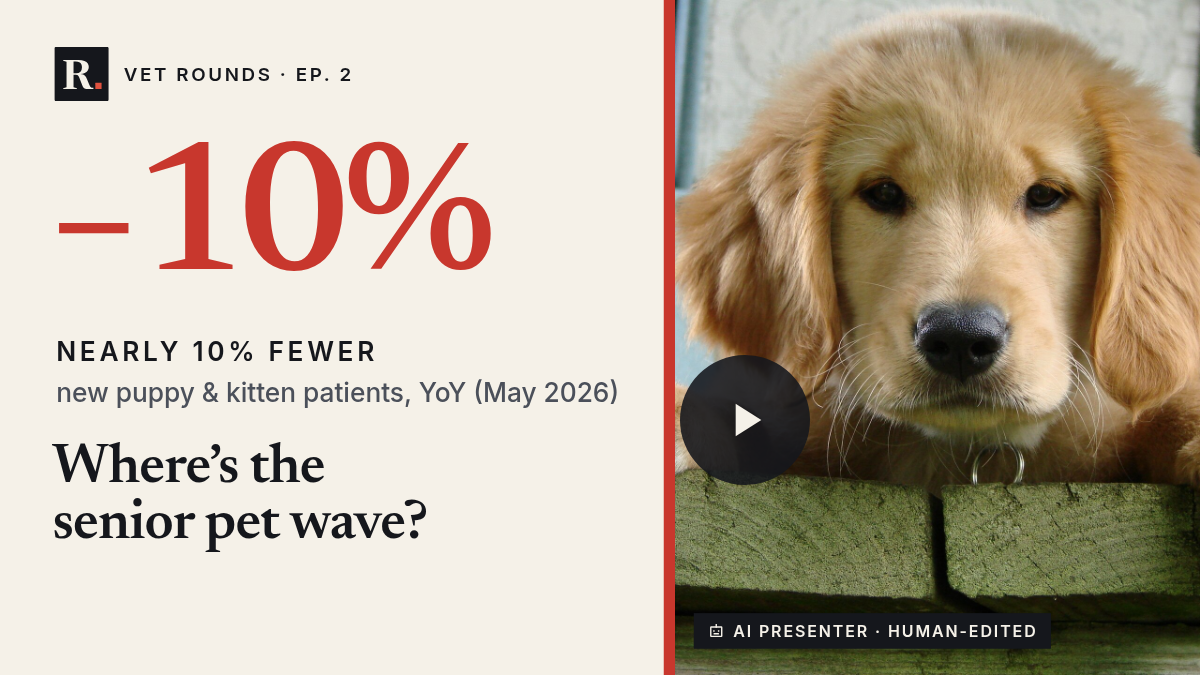
- New puppy and kitten patients peaked in 2021 and were down nearly 10% year over year as of May 2026, across nearly 6,500 US practices (Vetsource white paper).
- Growth in patients aged 8 and older has stayed near 0%, and with steady churn the average practice is now losing patients on net (Vetsource).
- Ackerman Group expects the post-COVID drop in dog adoptions to offset the coming senior-pet upside, with 2026 the fifth straight year of 2 to 3% invoice declines.
- Practice visits were down 3.0% in the week of Oct 11 to 17, 2026, with revenue up 1.3%; over 12 months visits are down 2.0% and revenue up 3.4% (Vetsource/AVMA tracker).
- In one Ackerman deal, a 14x EBITDA headline offer paid only 8x in cash at closing; the seller took a 10x cash, 13x total offer instead.
- Median advertised veterinarian pay is $135,000 (VeterinaryHires) to $140,000 (PawsRx); 7.4% of 2026 grads had no job offer when surveyed, up from 2.1% in 2022 (AVMA).
THE LEAD
This week's big story
New puppy patients are falling, and the senior wave isn't coming
Since 2021 the industry has told itself a comforting story. The pandemic pet boom would grow up, and around 2027–28 practices would see a wave of senior patients and the extra visits that come with them. A new Vetsource white paper, Where are the pandemic puppies and kittens?, says the data doesn't support it (Vetsource).
Vetsource analyzed transactional data from nearly 6,500 US practices, mostly general companion-animal clinics. 55% are independent and 45% are owned by a consolidator. Its key findings:
- New puppy and kitten patients peaked in 2021, as did patients aged 1–7. Patients aged 8 and older peaked earlier, in 2020.
- As of May 2026, new puppy and kitten patients were down nearly 10% from a year earlier.
- Growth in the 8+ age group has stayed near 0%.
- The age mix of the total patient population has stayed relatively stable, despite the 2020–22 spike in new patients.
The reason is churn. Patients lapse or die at a steady rate, so new patients aren't adding to the total. With fewer new puppies coming in, Vetsource says the average practice is now losing patients on net (Vetsource; Today's Veterinary Business, Oct 15).
Broker Ackerman Group reaches a similar view from another direction. Its Q3 Market Pulse says COVID pets will start becoming seniors soon, but that upside "is likely offset" by the post-COVID decline in dog adoptions. Dogs account for about 80% of general-practice visits, and Ackerman expects 2026 to be the fifth straight year of 2–3% invoice declines (Ackerman Group Q3 2026, PDF).
It fits the tracker. Over the last 12 months, visits are down 2.0% while revenue is up 3.4% (Vetsource/AVMA tracker, Oct 20). Growth is coming from price and from existing patients, not from more of them.
So what: don't budget for a demographic tailwind. The white paper's own recommendations are to recall lapsing patients, keep 1–7-year-old pets coming back, grow revenue beyond new-patient acquisition, and find out why clients leave (Today's Veterinary Business). In practice that means:
- Know your net patient number. For the last 12 months, take new active patients and subtract patients you lost (lapsed or deceased). If it's negative, you're the average practice.
- Run a lapsing-patient recall, not just reminders. Have the front desk call or email clients who are drifting before they're gone. Vetsource has a free lapsing-client toolkit with sample emails and phone and voicemail scripts. (Business operations only. Clinical intervals are your medical team's call.)
- Give the 1–7s a reason to stay. A wellness or membership plan is one way to do it. Both international deals in this week's Buyout Board are clinic groups built largely on their own pet health plans. If you don't offer one, put it on the 2027 agenda, and have your medical team set what's in it.
- Ask the ones who left. A two-question email to lapsed clients ("Where do you go now? What would bring you back?") tells you whether you're losing on price, access or service.
VITALS
5 numbers that moved
| Number | What it is | Source | |
|---|---|---|---|
| 1 | ~−10% | New puppy/kitten patients, YoY, as of May 2026 ("nearly 10%") | Vetsource |
| 2 | −3.0% | Practice visits, week of Oct 11–17 vs a year earlier (revenue +1.3%) | Vetsource/AVMA tracker |
| 3 | +2.6% vs −3.8% | Services vs products revenue, same week | Vetsource/AVMA tracker |
| 4 | −10.0% | Months of heartworm protection dispensed, YoY (flea/tick −9.8%) | Vetsource/AVMA tracker |
| 5 | +1.8% | Oregon visits YoY, the only state with positive visits. Oregon also leads revenue growth at 7.3% | Vetsource/AVMA tracker |
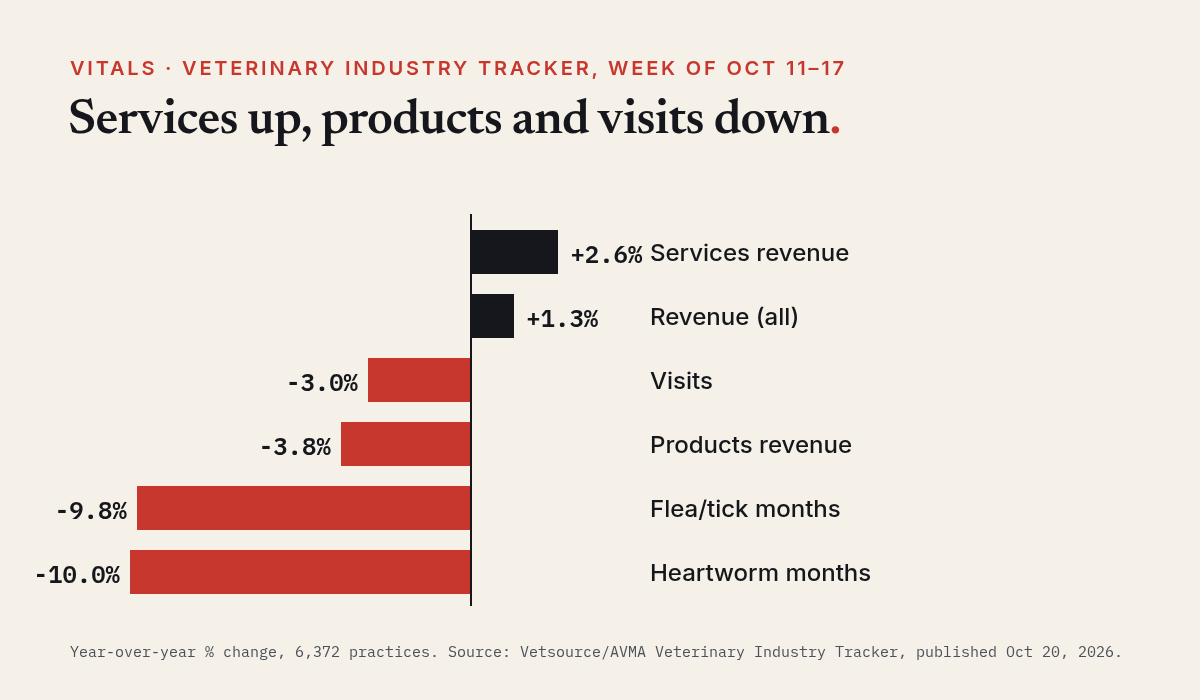
The tracker covers 6,372 practices, averaging $2.2M in revenue and 9.6K visits per practice over the last 12 months. Tracker figures can be revised as data comes in.
BUYOUT BOARD
Deals & ownership tracker
- What a "14x" offer can really pay. Ackerman's Q3 report walks through the sale of Boone Veterinary Hospital (Boone, IA; 4 DVMs, $3M+ revenue). The highest headline offer was 14x EBITDA, but it came with TopCo equity, hard-to-hit earnouts and only 8x in cash at closing. The owner chose Mission Pet Health instead: 10x cash at closing, 13x total once achievable revenue hurdles are met, plus associate retention incentives. Ackerman says cash at closing across its deals still runs 45–80% of the price, "very buyer dependent," and it expects two top-tier practices to close at 16x+ in Q4 (Ackerman Group Q3 2026, PDF). Ackerman is a broker, and these are its own transactions, not the whole market. Vet Rounds has no relationship with any broker.
- IDEXX bought CoVet, the AI ambient-scribe and workflow software, on Sep 16. Terms weren't disclosed. IDEXX says CoVet will keep integrating with non-IDEXX practice-management systems (IDEXX), and CoVet says pricing hasn't changed for now (CoVet Help Center). Ackerman's same report calls scribing software "AI 101" for practices.
- Abroad, buyers are paying for health plans. In Israel, Leox and insurer Phoenix are buying 85% of Haverim, a 10-clinic chain, at a valuation of NIS 240 million (about $77.4M). Most of Haverim's revenue comes from annual subscription plans (Calcalist, Oct 15). In Spain, IVC Evidensia added Grupo HVC in Catalonia: 9 centres, about €8M in revenue and 16,500 patients, of which 5,000+ are on HVC's own health plans (Redacción Médica, Oct 14).
So what: when you compare offers, line them up on cash at closing and on how realistic the earnout is, not on the headline multiple. Our guide to selling a vet practice lists the questions to settle first. Ask your own attorney and CPA before you sign anything.
PEOPLE
Hiring, pay and benefits
- What employers advertise for vets. VeterinaryHires' median posted pay for veterinarians is $135,000 (middle half $125,000–$145,000), from 717 listings at 601 employers. Emergency vets post at $145,000 and practice managers at $70,875 (VeterinaryHires, Oct 6).
- A second read. PawsRx's job-ad data puts the vet median at $140,000 (2,558 ads), vet techs at $27/hour, assistants at $19 and receptionists at $18. It also estimates that 13.7% of vets leave their practice each year, across 3,081 practices (PawsRx, Oct 18). Both are advertised pay, not take-home earnings.
- The new-grad market is loosening a little. 7.4% of 2026 grads had no job or advanced-education offer when AVMA surveyed them, up from 2.1% in 2022. That is still far below the nearly 40% of 2012. Private-practice starting pay averaged $133,056 (AVMA News, Oct 8).
So what: if your posted range sits below these medians, expect fewer applicants, and remember that a doctor who leaves can take client relationships along. Our vet tech salary guide shows how to build a defensible pay range.
Hiring? Post it on Rounds Jobs, free for independent clinics. We review every listing before it goes live, and listings that show pay go to the top. Post a job or browse open roles.
TRIAGE
3 things to handle this week
- Pull your new-patient count by year, 2019 to 2026, from your PIMS. Is your new puppy and kitten count running about 10% behind last year, as it is across Vetsource's data? Check your 1–7 and 8+ groups too.
- Calculate your net patient number for the last 12 months: new active patients minus lapsed and deceased. Put it on next month's management meeting agenda.
- Start one lapsing-patient recall list this week. Pick a single segment, such as 1–7-year-old dogs with no visit in 12–18 months, and have the front desk work it. (Operations only. Clinical recall intervals are your medical team's call.)
Previously in Vet Rounds
Last week, in Issue No. 1: vet price growth slowed to its lowest since 2021, we showed prices cooling while visits kept falling. This issue looks at where the patients went.
Get the business of vet practice in five minutes, every Monday.Free. Unsubscribe any time. We never sell or share your email.
Subscribe freeGet next Monday’s brief
Free, every Monday by 6 am ET. Five minutes, every number sourced.
Sources
All sources accessed October 2026 (PT). Figures marked calc are Vet Rounds arithmetic on the linked data.
- Vetsource: vetsource.com
- Today's Veterinary Business, Oct 15: todaysveterinarybusiness.com
- Ackerman Group Q3 2026, PDF: ackerman-group.com
- Vetsource/AVMA tracker, Oct 20: veterinaryanalytics.com
- lapsing-client toolkit: vetsource.com
- IDEXX: ir.idexx.com
- CoVet Help Center: help.co.vet
- Calcalist, Oct 15: www.calcalistech.com
- Redacción Médica, Oct 14: www.redaccionmedica.com
- VeterinaryHires, Oct 6: www.veterinaryhires.com
- PawsRx, Oct 18: pawsrx.io
- AVMA News, Oct 8: www.avma.org
Disclosure: Researched with AI tools. Written, edited and fact-checked by Matthew C. and our editorial team. Nothing here is clinical, legal or tax advice. Spot an error? Email hello@veterinaryrounds.com and we’ll correct it here and in the next issue.